
What Are The 4 Pillars Of Democracy?
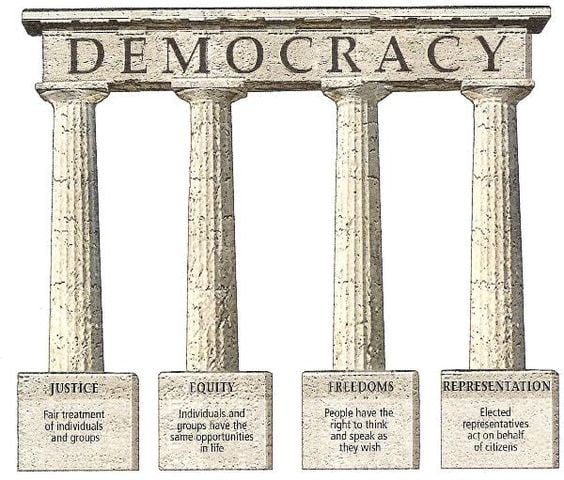
Democracy is one of the most widely followed systems of government in the world. It gives power to the people and allows them to choose their leaders through elections. However, democracy does not work only because people vote. It works because strong institutions protect citizens’ rights, keep the government accountable, and maintain law and order.
That is why we say democracy stands on four strong pillars.
In this detailed 2026 guide, you will learn the meaning of democracy, why these pillars matter, and how they keep a country free and fair.
| Pillar | Primary Role | Key Functions | Why It Is Important |
| Legislature | Makes laws | Drafts and passes laws, debates national issues, approves budgets, represents citizens, questions the government | Ensures people have a voice in law-making and keeps the government accountable. |
| Executive | Implements laws | Executes laws, manages administration, runs government schemes, maintains law and order, formulates policies | Ensures laws are effectively enforced, and public services are delivered. |
| Judiciary | Delivers justice | Interprets the Constitution, protects fundamental rights, settles disputes, reviews government actions, punishes lawbreakers | Safeguards justice, equality, and prevents misuse of power by any authority. |
| Media | Informs the public | Reports news, raises public awareness, investigates corruption, promotes transparency, acts as a watchdog | Keeps citizens informed and strengthens accountability in a democratic society. |
What Is Democracy?
Democracy means “rule by the people.”
The word comes from the Greek term “dēmokratia”, made from dēmos (people) and kratos (rule).
In a democracy:
- Citizens vote in elections
- People choose representatives
- Laws apply equally to everyone
- The government must answer to the public
Today, most modern countries follow representative democracy, where elected leaders make decisions on behalf of citizens.
Why Are the 4 Pillars of Democracy Important?
A democracy needs more than elections. It needs systems that:
- Protect rights
- Stop misuse of power
- Ensure fairness
- Keep citizens informed
These systems act like support pillars of a building. If a pillar becomes weak, democracy becomes weak too.
The 4 Pillars of Democracy
The 4 pillars of democracy are:
- Legislature
- Executive
- Judiciary
- Media
These four pillars work together to keep the government balanced and responsible.
Now let’s understand them one by one.
1) Legislature (Law-Making Pillar)
The Legislature makes laws for the country. It represents the people because citizens elect its members.
What the Legislature does
- Creates and passes new laws
- Debates national issues
- Approves budgets
- Questions the government
- Represents people’s needs and problems
In India, the Legislature includes Parliament (Lok Sabha and Rajya Sabha). In states, it includes the Legislative Assembly.
Why the Legislature matters
The Legislature gives people a voice in decision-making. It also checks the power of the government by asking tough questions and discussing public issues.
Without a strong Legislature, leaders could make rules without public input.
2) Executive (Implementation Pillar)
The Executive runs the government and implements laws.
It includes:
- The Prime Minister / President (depending on the country)
- Ministers and government departments
- Civil services and administration
What the Executive does
- Executes laws made by the Legislature
- Manages national security and law enforcement
- Runs government schemes
- Makes policies for the country
- Handles daily government work
Why the Executive matters
A country needs an Executive to actually deliver services, manage development, and maintain order.
However, the Executive must work within the law. It cannot act like a dictator. That is why other pillars monitor and control its power.
3) Judiciary (Justice and Rights Pillar)
The Judiciary protects the Constitution and ensures justice. It also ensures that everyone follows the law, including the government.
Many experts and institutions describe the judiciary as a key pillar that safeguards justice and equality in democracy.
What the Judiciary does
- Interprets the Constitution
- Protects citizens’ fundamental rights
- Punishes those who break the law
- Settles disputes fairly
- Ensures justice without discrimination
In India, the Judiciary includes:
- Supreme Court
- High Courts
- District and lower courts
Why the Judiciary matters
The Judiciary protects democracy because it prevents misuse of power.
If the government makes an unfair decision, courts can challenge it. This keeps citizens safe and ensures justice.
4) Media (Information and Watchdog Pillar)
The Media is often called the fourth pillar of democracy.
It includes:
- Newspapers
- Television
- Radio
- Digital media and news websites
- Independent journalists
The media plays a watchdog role by highlighting issues and keeping the public informed.
What the Media does
- Spreads news and information
- Raises awareness about public issues
- Exposes corruption and wrongdoing
- Gives a voice to people
- Questions leaders and policies
Why the Media Matters
A democracy needs informed citizens. Media helps people understand:
- What the government is doing
- What problems exist in society
- What changes do citizens need
Without free and responsible media, people may not know the truth. That can lead to misinformation and unfair governance.
How These 4 Pillars Work Together
The four pillars support each other through checks and balances:
- Legislature makes laws
- The executive implements laws
- The judiciary interprets laws and delivers justice
- Media informs citizens and holds power accountable
If one pillar becomes too powerful, democracy becomes unbalanced. That’s why all pillars must remain strong.
4 Pillars vs 4 Core Values of Democracy (Important Difference)
Many people confuse the “pillars” of democracy with the “values” of democracy.
✅ Four pillars are institutions that support democracy.
✅ Core values are principles that guide democracy.
In India, the Constitution’s Preamble highlights values like:
- Justice
- Liberty
- Equality
- Fraternity
So remember:
Pillars = Legislature, Executive, Judiciary, Media
Values = Justice, Liberty, Equality, Fraternity
Both are important, but they are not the same.
Why Democracy Is Considered the Best System
Democracy offers many benefits compared to a dictatorship or a monarchy.
Key advantages
- People choose their leaders
- Power does not stay with one person
- Citizens can criticize the government
- Laws protect basic rights
- Elections allow peaceful change
However, democracy works only when institutions remain strong, and citizens remain active.
Challenges Faced by Democracy in 2026
Even in 2026, many democracies face challenges like:
- Corruption and misuse of power
- Fake news and misinformation
- Weak justice delivery in some areas
- Political pressure on institutions
- Low voter awareness
That is why protecting democracy pillars matters more than ever.
How Citizens Can Strengthen Democracy
Democracy needs public participation. Here’s how citizens can help:
- Vote responsibly
- Avoid fake news and verify information
- Respect laws and constitutional rights
- Raise issues peacefully
- Support independent media
- Demand accountability from leaders
When people stay aware and active, democracy grows stronger.
Conclusion:
So, what are the four pillars of democracy?
The four pillars of democracy are:
- Legislature – makes laws
- Executive – runs the government
- Judiciary – delivers justice
- Media – informs and acts as a watchdog
Together, these pillars protect people’s rights and keep government power under control. When they remain strong and independent, democracy remains strong too.
FAQs:
A. The 4 pillars of democracy are the Legislature, Executive, Judiciary, and Media.
A. Media informs people, raises public issues, and holds leaders accountable, so many call it the fourth pillar of democracy.
A. The judiciary protects the Constitution, delivers justice, and safeguards citizens’ rights.
A. India’s Preamble highlights Justice, Liberty, Equality, and Fraternity as key values.
